03 Equity Valuation
A-Types and Characteristics of Equity Securities
Categories of Stocks:
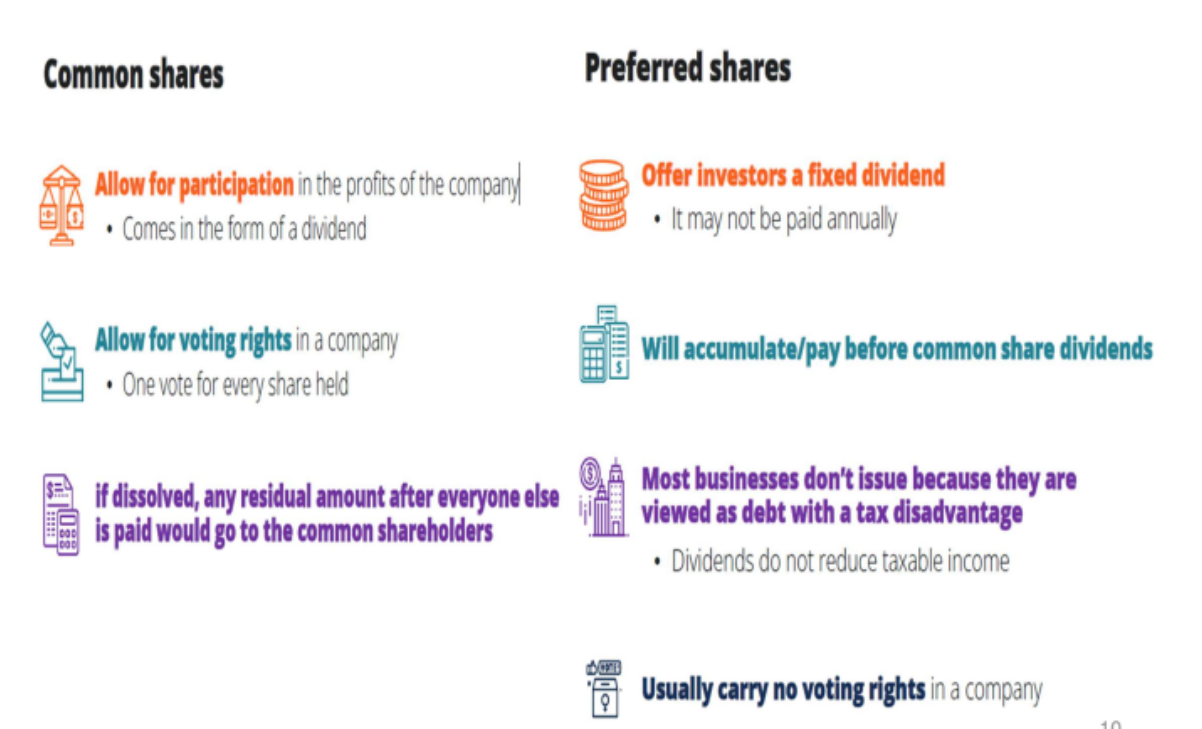
Common stock
- You are a partial owner of the company.
- Shareholders have voting rights.
- Companies may pay dividends but are not obligated to do so.
- Common shareholders receive dividends only after preferred shareholders.
- In bankruptcy/liquidation, common shareholders are last in line (after creditors, bondholders, and preferred shareholders).
Preferred stock
- Hybrid Security – Combines traits of debt (fixed dividends) and equity (ownership, no maturity).
- No Voting Rights – Unlike common stock, preferred shareholders cannot vote on corporate matters.
- Fixed Dividends – Typically higher than common stock dividends, but not guaranteed (unlike bond interest).
- You have a greater claim on the company’s assets than common stockholders. Preferred shares > common shares
B- Intrinsic Value Vs. Stock Price
- Par Value
- Book value of the share (balance sheet) = (Total Assets – Total Debt)/Nber of shares.
- The stock price (P0) current market price, det by the supply and the demand of the stock in the mrk
- The intrinsic value (^P0) “true” value of the stock, based on the future earnings a company is expected to generate
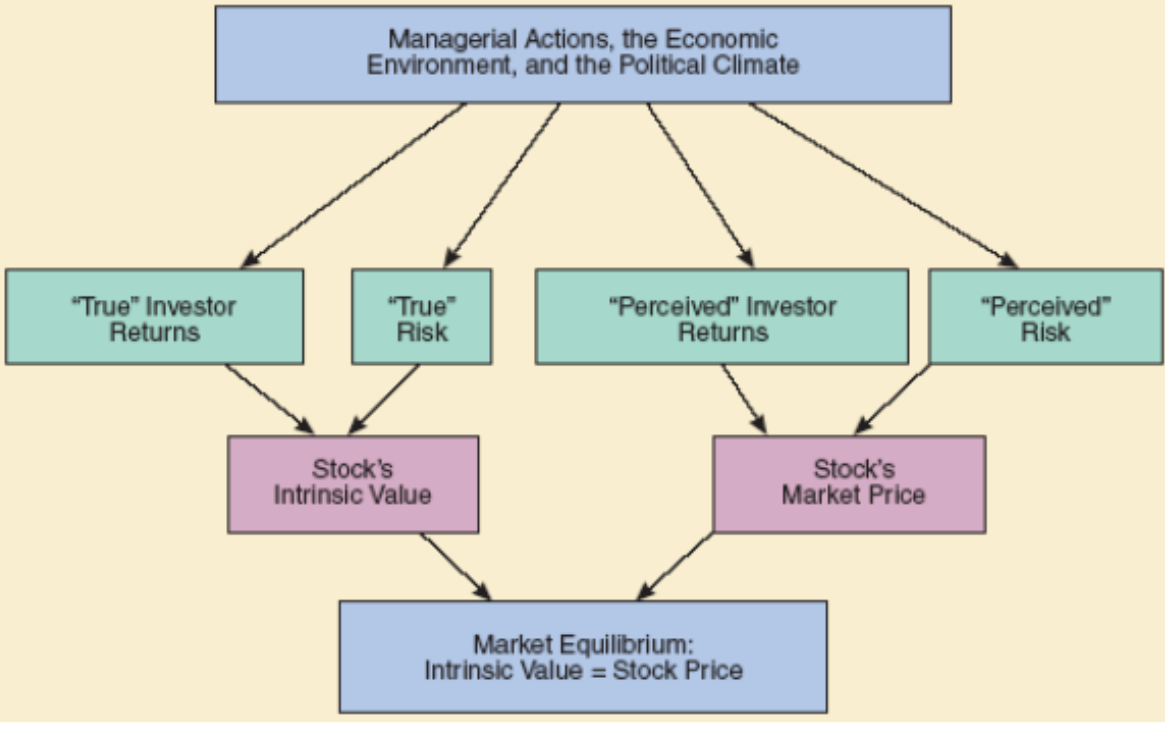
Estimated Value and Market Price
A stock is:
- Estimated Value > Market Price ==> Undervalued ==> buying opportunity
- Estimated Value < Market Price ==> Overvalued ==> selling opportunity
- Estimated Value = Market Price ==> Fairly Valued
Price to pay to buy a stock
an investor should:
- Predict future CFs (future dividends)
- Set the RRR
C- EPS, DPS and Retain ed earnings
-
A profit earned by a corporation (net income) is either:
- re-invested into the business (retained earnings)
- distributed to shareholders (pay-out)
-
Retention Ratio = Retained earnings / Net income
-
Dividend Pay-out ratio = pay-out / Net income
-
Retention ratio = 1 – Dividend payout Ratio
-
EPS = Net income / Number of shares
-
Dividend per share (DPS) = EPS x Dividend payout Ratio
-
Dividend per share (DPS) = Dividend amount / Number of shares.
-
Retained earnings = Net income – Dividend amount
-
Retained earnings = Retention Ratio x Net income
D- Determining equity values: the Discounted Dividend Model
Present value models
- estimate the intrinsic value of a security (the present value of the future benefits expected to be received from the security)
- Investors defer consumption today for future returns.
Free Cash Flow to Equity (FCFE) Models
- Estimates value based on cash flows available to shareholders after reinvestment needs
- Firms with irregular/no dividends.
Dividend Discount Models (DDM)
- Estimates value based on expected dividends
- Best for stable, dividend-paying companies.
Specifies cash flows from a common stock investment to be dividends.
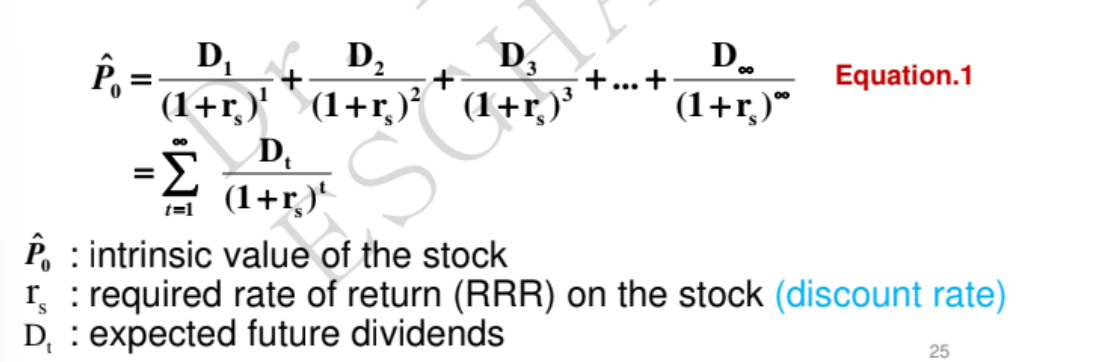
1- Constant Dividend Growth (Gordon) Model
A simplified Dividend Discount Model (DDM) that assumes:
- Dividends grow at a constant rate (
) forever.
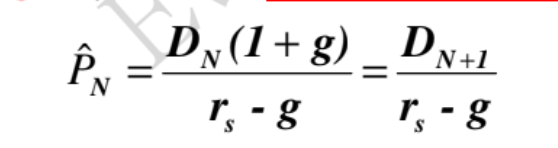
g< r.
Expected Rate of Return (rS), Dividend Yield and Capital Gains Yield on Constant Growth Stock
Your expected rate of return, is provided from the dividend received (Dividend yield) and from the appreciation (or depreciation) of the value of the stock you hold (Capital Gain (or Capital Loss) yield)
Where Does “g” Come From?


2- Constant Dividend Model
g=0 ==> perpetuity
- Preferred stockholders receive a fixed dividend

3- Multistage Dividend Discount Model
For new companies, Dividends are fluctating
2 stage DDM
- High-Growth Phase (Short-Term) for N years with dividends growing at a supernormal rate
- Sustainable Growth Phase (Long-Term) Uses the Gordon Growth Model to calculate the terminal value N is called the Horizon date.
E- Determining the Money-Weighted Rate of Return (MWRR)
Step 1: Identifying the Cash Flows and their timings:
Step 2: Net the cash flows for each time period and set the Present Value of cash inflows equal to the present value of cash outflows.

Step 3: Solving for Money-Weighted Rate of Return
(MWRR)
Step 4: Computing the Annualized Return
