04 Bonds
Companies raise capital through equity and Debt (bank loans + bonds)
1. Key features of bonds
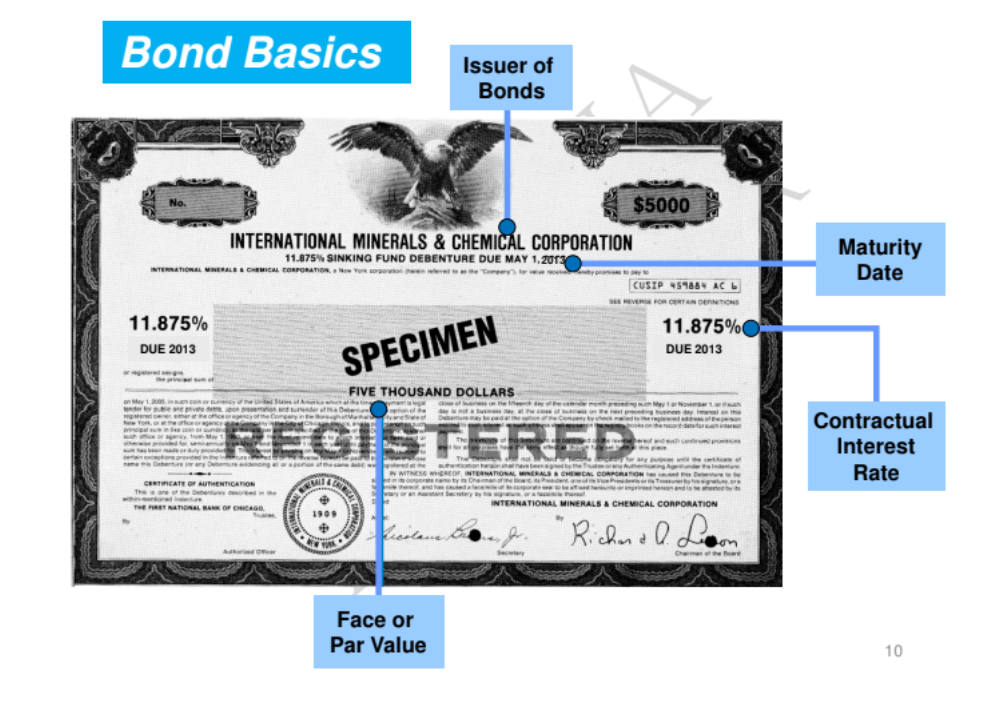
Par value (principal of a bond)
Coupon interest rate :
= nominal rate (yield)
= Stated interest rate (generally fixed) paid by the issuer each year.
Coupon interest rate * Par value = Dollar Payment of interest
- Yield to maturity: rate of return earned on a bond held until maturity.
Maturity
- The tenor (= term to maturity) time remaining until the bond's maturity date.
- Money market securities fixed-income securities with maturity <= one year.
- Capital market securities are fixed-income securities with maturity > one year.
2. Bond Pricing and listings
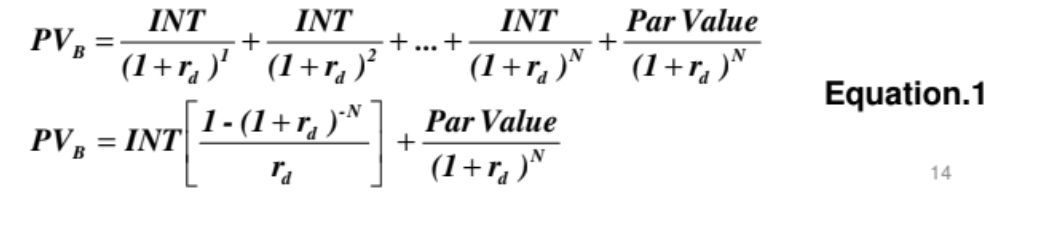
What is the discount rate (rd)?
The market discount rate is used in the time-value-of money calculation to obtain the present value.
rd =/=the coupon interest rate (i)
Bond values over time
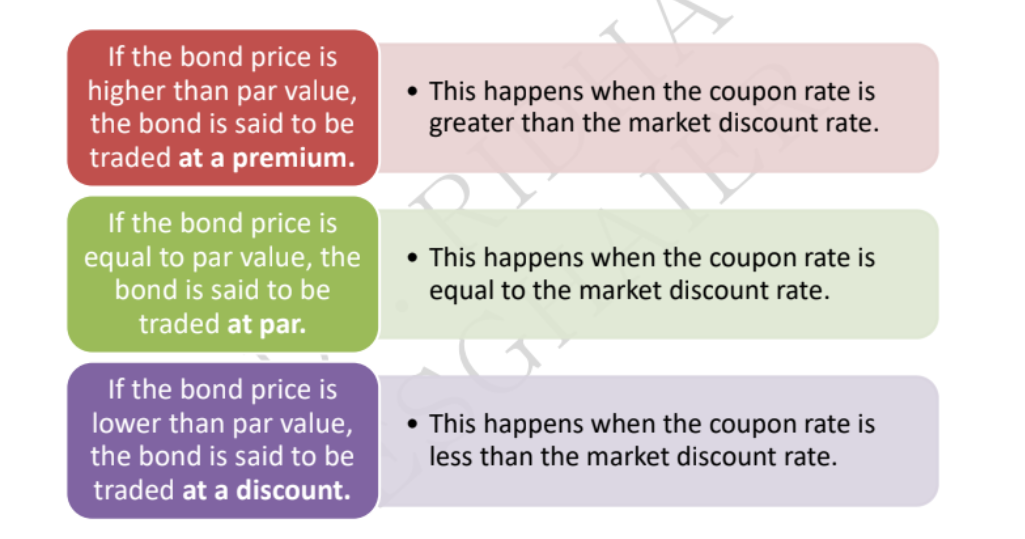
At maturity, the value of any bond must equal its par value.
if rd is constant:
- The value of a premium bond would decrease over time, until it reached the par value.
- A value of a par bond stays at.
- The value of a discount bond would increase over time until it reaches the par value.
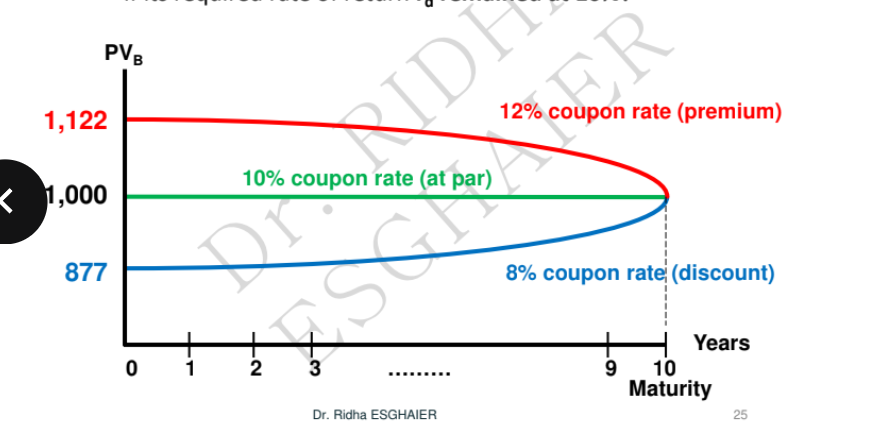
- If i = rd then, PVB = Par Value ► Par bond
- If i > rd then, PVB > Par Value ► Premium bond
- If i < rd then, PVB < Par Value ► Discount bond
Points = % Discount/Premium (1 point = 1% of face value).
3. The Yield to Maturity (YTM)

- When Yield (YTM) goes up, the Price of the bond goes down.
- When Yield (YTM) goes down, the Price of the bond goes up.
Pricing Bonds with Spot Rates

4. Current Yield, Capital Gains Yield and Total Return
YTM = Current Yield + Capital Gains Yield.

5. Semiannual Bonds

6. Bond Pricing between two coupon payment dates
Clean price, Full price and Accrued interest
You must account for accrued interest
- Clean Price: Bond price excluding accrued interest (just the market value).
- Dirty (Full) Price: Clean price + accrued interest (what you actually pay).
==> dirty price = clean price + Accrued interest
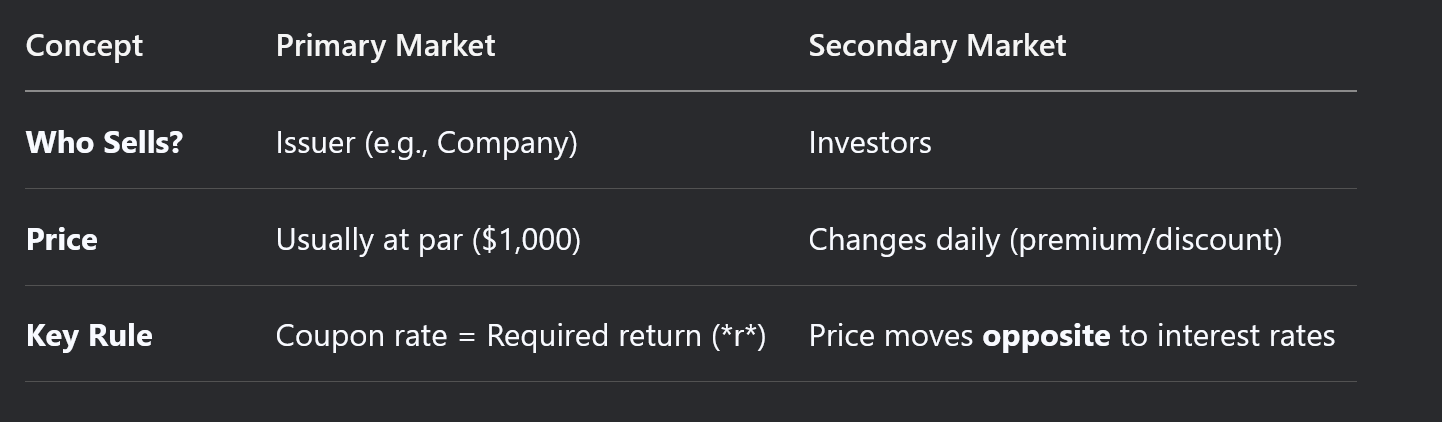
Secondary market: Prices fluctuate with interest rates (↑ rates = ↓ prices)
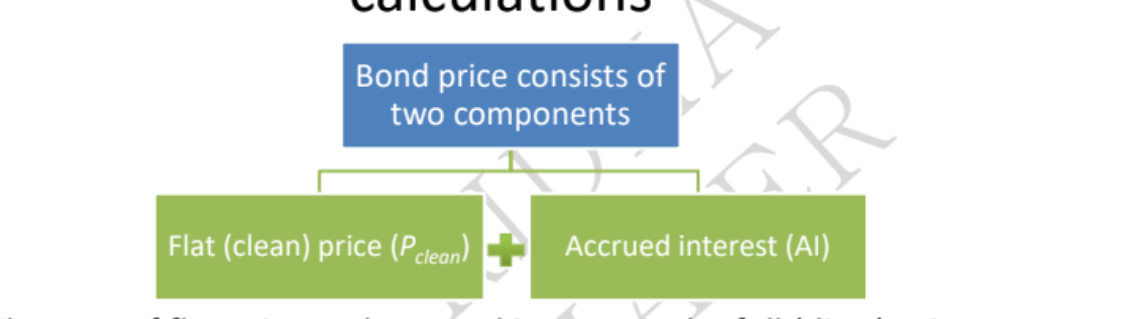
- Bond prices rise daily between coupons (accrued interest piling up).
- On payment day: Price drops (like a sawtooth).
- You always pay the dirty price—no free lunches!
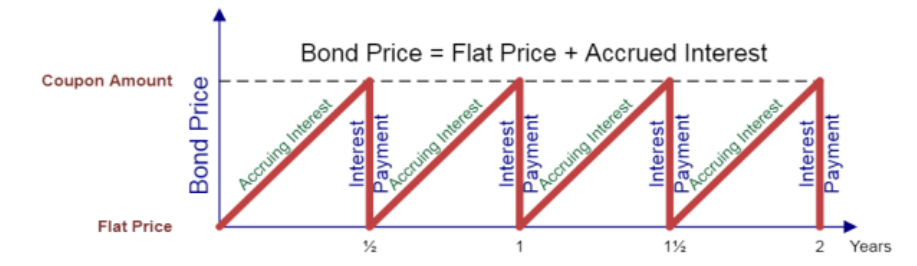
Primary Market (Where Bonds Are Born)
Issuer (e.g., a company) sells bonds directly to investors.
Coupon rate = Investors’ required return (r).
Exception: If demand is super high/low, bonds may sell above/below par.
Secondary Market (Where Bonds Trade Between Investors)
-
Pricing: Bonds rarely trade at par because interest rates change constantly.
- Premium: Price > Par → Yield < Coupon Rate (investors pay extra for higher coupons).
- Discount: Price < Par → Yield > Coupon Rate (investors get a deal for lower coupons).
-
Interest Rate Rule:
- ↑ Rates → ↓ Bond Prices (existing bonds with lower coupons lose value).
- ↓ Rates → ↑ Bond Prices (existing bonds with higher coupons gain value).
Bond Pricing between two coupon dates
Full Price calculation
- Calculate the (clean price) bond’s price right after the last coupon payment.
- Discount all future cash flows (coupons + face value) to the last coupon date.
- Measure the time between: Last coupon date (when the seller got their last payment) and Settlement date
- Add Accrued Interest: Capitalize = Grow the clean price by the daily interest

Actual/Actual Day Count
-
- Count ALL actual days between dates (even weird months like February in leap years).
- First day = COUNTED | Last day = NOT COUNTED
7. Zero-coupon Bonds
- zero coupon bonds
- original issue discount (OID) Bonds.
Why Buy Them?
- Predictable Profit: Know exactly what you'll get at maturity.
- Less Reinvestment Risk: No coupons to reinvest (good when rates are falling).
- Cheaper Entry: Pay way less than face value upfront
⚠️ Watch Out!
- Tax Trickery: In the U.S., you pay taxes on "imputed interest" yearly (even though you get no cash until maturity!).
- Sensitive to Rate Changes: Prices swing wildly if interest rates move (longer maturities = bigger swings).
*For every 1% rate increase, a bond’s price drops by roughly its duration., A 1% rate rise → 30-year zero drops ~30% (!), but a 5-year zero drops only *~5
8. Callable Bonds
- Call Provision
- Contractual clause permitting early redemption.
- Specifies call schedule and call premium structure.
- Call Price

-
Call Premium
- Initial Premium: Often equals one year’s coupon payment

- Initial Premium: Often equals one year’s coupon payment
-
Investors must evaluate both YTC and YTM to assess worst-case returns.
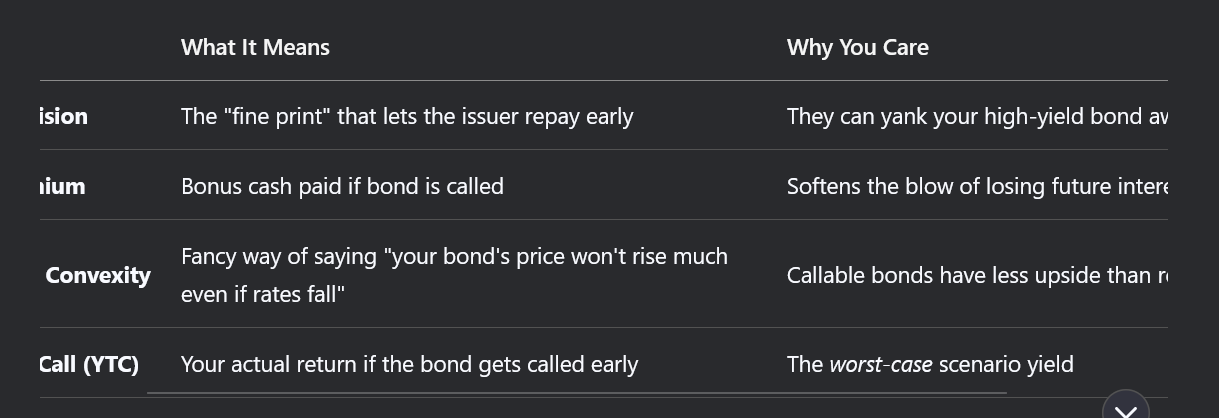
Cause of calling a bond
- A decline in market interest rates (rd).
==> good for the company but bad for the bondholders
🤯 Why This Sucks for You
| Scenario | What Happens | Why It Hurts |
|---|---|---|
| Rates ↑↑↑ | Issuer won't call (your coupon is now below market) | You're trapped earning less than new bonds pay |
| Rates ↓↓↓ | Issuer will call (to refinance cheaper) | You lose your high coupon and must accept lower yields |
Translation: Heads they win, tails you lose.
💰 The Only Consolation
- Callable bonds pay higher coupons upfront to compensate for this risk.
But is it worth it?
✅ Yes if you think rates will stay flat/rise slightly.
❌ No if you expect big rate drops (your bond will vanish).